Insurance: Part One – Insuring the path to a greener future
15 March 2021 | Written by Daniel Gill
INSURANCE: PART ONE: INSURING THE PATH TO A GREENER FUTURE
During 2020, whilst necessarily focus has been on response to the pandemic, the UK experienced one of its hottest summers ever. This continues a distinct trend of the warmest years on record[1]. A consistent increase in temperature is the strongest indicator that our climate is changing, and we are entering a crisis period.
This is the first in a short series of articles looking to delve into what the impacts of climate change mean for life insurers and how insurers can prepare themselves to meet the challenge of navigating related financial risks and any regulatory requirements that come with it.
Why is climate change relevant to you?
Long-term natural patterns are difficult to predict. However, the impact of human activities over the last few centuries is undeniable; the last few decades have seen changes to our natural environment well beyond anybody’s expectations. The knock-on effects on the life insurance market are likely to be varied and far-reaching; we see increased incidence and transmission of certain diseases[2], increasing numbers of weather-related natural disasters, as well as extreme high air temperatures leading to increased deaths[3].
Climate change is an era defining challenge, recognising it is not enough. The insurance industry is faced with a myriad of questions and a set of unique challenges to counter its impacts. Immediate action is vital in ensuring a smooth transition to a “greener” economic environment. Uncertainty will provide diverse opportunities for actuaries to demonstrate their capabilities to provide unique insights and solutions to manage risks and also potentially create value; whether that is looking towards more sustainable investments to back insurance liabilities or introducing new products to support policyholders in switching to “greener” behaviours.
To understand the looming threat, attention is now being directed towards understanding and quantifying the financial impacts of climate change.
Back in 2015, Mark Carney categorised the financial risks posed by climate change into three types[4]:
1. Physical risk – there will likely be direct physical impacts, such as changes in mortality and disease inception rates.
2. Transition risk – the strategic risks of transitioning to a greener economy could lead to volatile or ‘stranded’ assets for industries which rely on new-renewable energy.
3. Liability risk – there is potential for a liability risk stemming from losses incurred when businesses or individuals seek compensation for the adverse impacts suffered from physical or transition risks.
This distinction has been key in helping firms better understand the types of risks within their portfolios and how those risks are expected to evolve over time. For example, while physical risks might be immediately obvious (such as damage to property within a life insurers investment portfolio or excess mortality during extreme weather), insurers have been reminded to consider their exposures to the risks resulting from a transition to a greener economy. These are much less obvious to many companies and as increased information and disclosures become available, firms will be able to take better action based on more informed decisions.[5]
What is the regulator saying?
In April 2019, the Prudential Regulatory Authority (PRA) issued a Supervisory Statement (SS3/19) with guidance for climate risk management. In July 2020, the (PRA) issued a letter addressed to CEOs in line with Supervisory Statement (SS3/19) suggesting enhancements to the existing regulatory framework. This was based on feedback collected from the insurance stress scenario test carried out from October 2019 to March 2020 which focused on the mitigation of climate change risks.
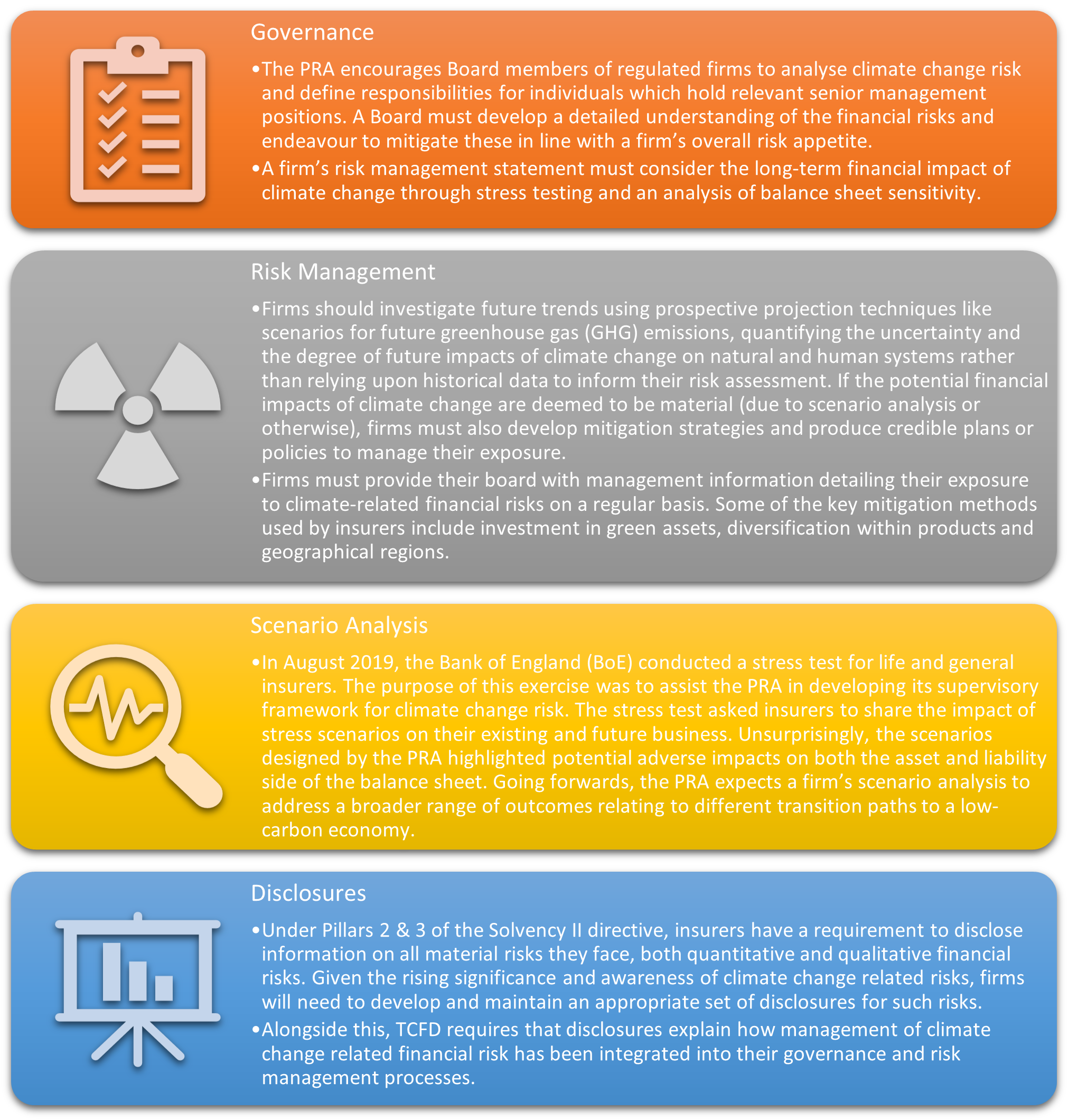
The PRA’s review of existing practices in the banking and insurance sectors, highlighted that firms’ existing efforts to manage these financial risks required a more defined and strategic approach. Furthermore, in July 2020, the PRA issued a letter to CEOs of regulated firms stating that “firms should have fully embedded their approaches to managing climate-related financial risks by the end of 2021.”[6]. Thus, there is now a clear expectation and obligation for firms to act. They must develop plans for climate change which are in line with the nature, scale, and complexity of their business operations by considering governance, risk management, scenario analysis and disclosures. A summary of requirements in these areas is shown in the graphic below and a more detailed examination will be presented in subsequent articles in this series.
In addition to the PRA’s statements, in November 2020, the UK’s Chancellor of the Exchequer Rishi Sunak also announced that the UK would become the first country in the world to make disclosures in line with the Task Force on Climate-related Disclosures (TCFD) mandatory by 2025[7].
Summary
We believe that firms will, over time, develop their ability to control the financial risks posed by climate change and embed the necessary regulatory controls into its existing supervisory framework. It remains to be seen how most firms will respond in both the short and longer term. However, stepping back and looking at what the recent regulatory changes are trying to do, the proposed changes in supervision and requirements appear proportional and sensible. With at least one of the largest UK insurers target “net zero carbon” by 2040 it is clear some in the industry agree.
Whether or not firms agree, in the PRA’s letter to CEOs in July 2020, the regulator gave a clear indication of its expectation that firms must have refined and ratified their approaches to these risks by the end of 2021.
4most has established a dedicated team to understand the impacts of the latest findings and develop a deeper understanding of how firms can respond to these new climate change requirements. 4most have developed several tools to help firms begin their journey towards assessing and managing their climate change related finance risk, including:
· a methodology for assessing a firm’s readiness for managing climate change risks,
· an approach to incorporate climate change transition risks into scenario analysis of corporate bond portfolios, and
· a methodology to identify the climate change related risks within investment and insurance portfolios.
We will continue to delve deeper into what this means for life insurers and share further thoughts and comments over the coming weeks through a series of exploratory articles.
DO YOU HAVE ANY QUESTIONS? Please contact info@4-most.co.uk
[2] https://www.who.int/news-room/fact-sheets/detail/climate-change-and-health
3] Death toll exceeded 70,000 in Europe during the summer of 2003
[4] https://www.bankofengland.co.uk/-/media/boe/files/speech/2015/breaking-the-tragedy-of-the-horizon-climate-change-and-financial-stability.pdf?la=en&hash=7C67E785651862457D99511147C7424FF5EA0C1A
[5] https://www.bankofengland.co.uk/knowledgebank/climate-change-what-are-the-risks-to-financial-stability
[6] https://www.bankofengland.co.uk/-/media/boe/files/prudential-regulation/letter/2020/managing-the-financial-risks-from-climate-change.pdf?la=en&hash=A6B4DD1BE45B2762900F54B2F5BF2F99FA448424
[7] https://gsh.cib.natixis.com/our-center-of-expertise/articles/the-uk-about-to-impose-mandatory-tcfd-climate-disclosure-and-to-issue-a-sovereign-green-bond#:~:text=In%20November%2C%20the%20UK’s%20Chancellor,the%20world%20to%20mandate%20economy%2D
Author

Interested in learning more?
Contact usInsights
2026 IFRS 9 benchmark for Dutch banks: interest-only mortgage overlays remain strikingly high
14 Sep 26


4most extends partnership with Commercial Bank of Dubai to support model risk management enhancement
13 Aug 26